 Online stores & membership sites
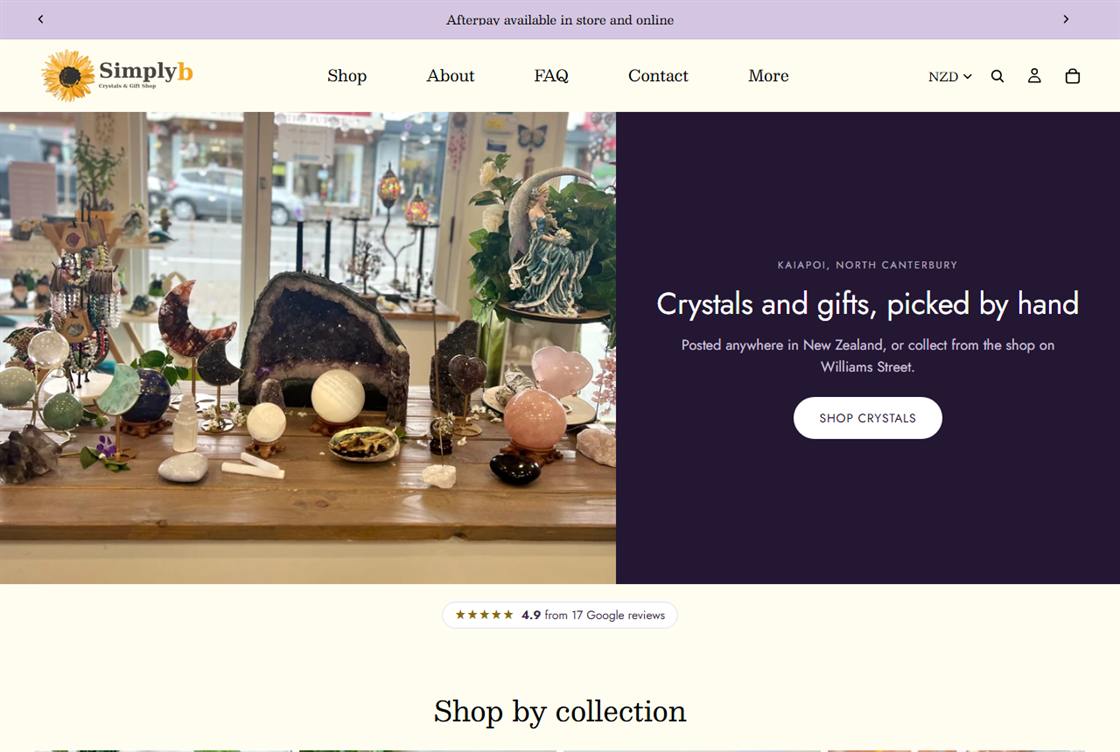
Simplyb Crystals & Gift Shop
- Client
- Simplyb, Kaiapoi
- Role
- Store Manager & Technical Lead
- Since
- July 2025, ongoing
A gift shop in Kaiapoi with a website that couldn't take an order, and a business still being run on paper behind it.
Where it started
The shop opened in early 2019 as a home-based side project selling crystals locally in North Canterbury, and grew on local support alone into a main-street store on Williams Street. It is a family business, and Rune runs it day to day rather than working on it at arm's length.
It wasn't invisible online. There was a basic brochure website, and a Facebook page where new stock was posted by hand every time a box arrived. Neither could take an order. The business itself ran the way it always had: sales written down by hand, stock counted on paper, and nothing online connected to either.
So the honest description is an online presence with no online operations. Rune was brought in with one brief: replace the manual processes with digital ones.
What Rune built
One piece of software does all of it: the website, the till on the counter, and the jobs that used to be done by hand out the back. All three work from the same set of records, so the shop floor and the website have never disagreed about how many of something is left.
- The Shopify shop itself, built and looked after end to end: how it looks, how products are grouped so people can find them, and the checkout.
- A till for the counter, built from scratch, including layby. It takes the stock straight off the same shelf count the website sells from.
- Stock-takes by barcode and photo, with a way to update a lot of products at once. It replaced the paper count outright.
- Trade Me sales handled automatically. A sale on Trade Me now becomes a real order in the shop's own system, ready to pack and track, and the stock count drops the moment a courier is booked. Before this, those sales did not show up in the shop's figures at all.
- Courier booking, with rural delivery detected from the address and priced into the quote automatically.
- Reminder emails to people who put something in their basket and left without buying, plus loyalty vouchers issued at the till.
- Social posting. One click to put a product on Instagram, and a small add-on for the Chrome browser that fills in Facebook's post box for the parts Facebook won't let software do on its own. It replaced the job that used to be done by hand every time stock arrived.
- A tool that writes the Google wording for every product at once. It drafts the title and the short description that get sent to Google, and nothing is saved until a person has read it.
- Packing slips made from what the system already knows, so they work from a phone without anyone logging in to the back office, and they cover Trade Me sales too.
None of it was bought off the shelf. Passwords and access codes are kept out of the code itself, which a security review confirmed, and there are 263 checks that run by themselves before any change reaches the shop, so a change that would break something gets stopped before anyone sees it.
What changed
The share of products carrying a title and description written for search went from about 4% to 98%, and all 65 groupings of products picked up both, where before they had neither. Rune built 16 new groupings around how people actually shop, and found one that had quietly swollen to 4,064 products.
The photo backlog fell from roughly 1,800 products to 1,259 of 2,812 active ones, so 44.8% are still waiting on a photo. Every figure in this section comes from a full list of every product in the shop, counted on 8 September, not from a sample.
Those two things have to meet for a product to sell itself, and this is where that stands: 1,508 products, 54% of the shop, now have both a photo and their own wording. The writing is effectively finished. The photography is what is left, and it is the slower half, because it needs someone standing in the shop with a camera rather than a tool that can be pointed at every product at once.
Online orders moved from about 3 a week to 9 in the week of 24 August. Visitor numbers stayed flat, so that came from more of the same visitors deciding to buy: out of every thousand people who came to the site, 22 bought instead of 8. Two checks sit behind those numbers. Rune compared 425 counter sales against the website's own records one by one and every single one matched, and after Google complained about the product information, went through all 4,151 items to see which barcodes were real.
The 9-order week was a spike, not a step change, and the weeks either side sit nearer two. When the traffic was checked properly in September, about 39% of recent sessions turned out to be overseas robot traffic rather than people, so the real visitor numbers are lower and flatter than the figures first suggested.
And the 98% is the wording only. Google will not put a product in its shopping results at all without a photo, so the 1,259 still waiting on one cannot appear there yet, however well they are described. Read the two numbers together, not separately: 98% described, 54% actually ready. Better you hear all that here than find it later.
What broke, and what Rune did about it
This is the part worth reading if you are deciding whether to hire someone. Everything below happened in production.
The picker was not broken. It was starved. Incident 05, where the first fix was wrong
01A paid order silently never shipped
Order #2892 was paid for and recorded correctly, then sat in the queue unsent, with no error message anywhere. The shop's software was handing Shopify an empty space where the tracking link should go. Shopify refused it and said nothing about why.
The fix was to leave that space out altogether rather than send it empty. Rune then went looking and found the same hidden fault sitting in the way ordinary online orders were handled. It had not gone off there yet. It would have.
02A courier booking that looked like a parcel-size problem
One order kept returning "no courier options for this parcel or address", including with a hand-typed custom size, which ruled out the parcel. The real cause was the address: street, suburb, city and country had all been typed into one box, leaving the suburb box empty, so the courier couldn't work out which delivery area it was in.
Rune added an address the staff can edit, which now warns them when an address has been typed in that way, so they catch it at the counter before they book the courier.
03The AI kept ignoring a hard character limit
The short descriptions Google shows under a product were being drafted by AI, and they kept coming back 8 to 30 letters too long for Shopify's limit of 160, even though the instruction said 160 maximum. An AI treats "maximum" as a strong suggestion.
Rune stopped rewriting the instruction and made the software enforce the limit itself, cutting at the last whole word. Limits are enforced that way everywhere now, rather than being asked for politely.
04Staff could not delete a bad photo
The staff member doing the photography reported that adding a good photo left the bad one in place, with no way to remove it without going into Shopify directly. Three causes had stacked up: a new photo was added alongside the old one instead of replacing it, the editing screen only knew about one photo at a time, and the single delete button deleted every photo on the product. So the one button that looked like the fix would have destroyed her new photo too.
Rune replaced it with a proper set of photos, a delete button for each one and a way to choose the main image. Then the change took three refreshes to show up, which turned out to be a second fault: browsers had been told to stop holding on to old copies of the photo pages, but nobody had told them the same about the main ones.
05Every social post was a pendulum
The tool that picks a product to post kept choosing pendulums. It was not broken, it was starved: staff had photographed two big batches of pendulums one after the other, about 57 of them, and those filled up the whole list of newest products it had to choose from. The first fix made that list longer and went live. It didn't work, and the person using it said so.
The second fix went after the cause instead of the symptom: a limit on how many products of the same kind are allowed in the running before one is picked. The first attempt was wrong, and it was the person using it who caught the mistake.
06Google rejecting the product data
Google reported bad barcodes right across the shop's products. The website was sending Google the shop's own 8-digit till codes as though they were the worldwide barcodes printed on a manufacturer's packaging. A check of all 4,151 products found 3,762 till codes, 43 real barcodes, and one number pasted in from somewhere else entirely.
The till codes had to stay, because the shop scans them at the counter, so the fix was to stop sending them to Google: hand-written product information that only passes on a barcode when it is genuinely 12 to 14 digits long. Confirmed working on the live site.